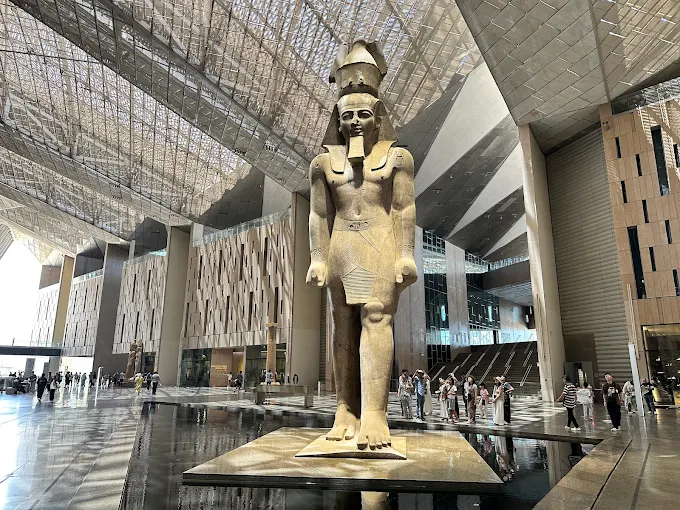

The Grand Egyptian Museum’s Marvel: Exploring the Hanging Obelisk

Welcome to our in-depth exploration of the Hanging Obelisk at the Grand Egyptian Museum (GEM)—a remarkable fusion of ancient Egyptian heritage and modern engineering. As the world’s first suspended obelisk, this monument redefines how historical artifacts are displayed and experienced, offering visitors a perspective never seen in its 3,500-year history.
Origins of the Hanging Obelisk
The Hanging Obelisk traces back to Pharaoh Ramses II (1279–1213 BCE), one of Egypt’s most celebrated rulers. Originally erected in Tanis, it was carved from red granite and inscribed with hieroglyphics celebrating Ramses II’s divine authority, military triumphs, and devotion to the gods.
Discovered in fragments during 20th-century excavations, it underwent meticulous restoration before being reimagined in a suspended installation at GEM. Elevating the obelisk above the museum’s 30,000-square-meter plaza allows visitors to interact with it in ways impossible when it stood traditionally on the ground.
Architectural Marvel: Design and Engineering
Standing approximately 16 meters tall and weighing 80–100 tons, the Hanging Obelisk is suspended on a four-column support system, allowing visitors to walk beneath it and view inscriptions that were previously hidden.
Advanced engineering minimizes vibrations and protects the monument, while its striking design transforms the obelisk into an interactive, awe-inspiring experience. This combination of preservation and innovation highlights the seamless dialogue between ancient craftsmanship and modern technology.
Cultural Significance and Symbolism
In ancient Egypt, obelisks symbolized the sun god Ra, connecting the earthly and divine realms. The Hanging Obelisk continues this tradition while serving as a modern emblem of Egypt’s cultural identity. Known as the “Tower of Ascendance,” it bridges past and present, celebrating Ramses II’s monumental legacy and Egypt’s architectural ingenuity.
Engraved with “Egypt” in multiple languages, the obelisk extends a universal welcome to visitors worldwide. Its placement near the Giza Pyramids enhances the immersive experience, linking the grandeur of ancient monuments to GEM’s cutting-edge museum design.
Visitor Experience and Preservation
As the first artifact visitors encounter at GEM, the Hanging Obelisk guides them into a journey through Egypt’s dynastic history. Its upward view reveals hidden hieroglyphics, offering insights into ancient construction techniques, religious symbolism, and pharaonic power.
Suspension protects the monument from environmental wear, ensuring its longevity. Special lighting and design elevate its presence as both an educational and visually captivating attraction for tourists globally.
Comparative Perspective: Traditional vs. Hanging Obelisks
| Feature | Hanging Obelisk (GEM) | Traditional Obelisks |
|---|---|---|
| Placement | Suspended above a plaza | Ground-mounted |
| Viewing Perspective | Look up to see hidden inscriptions | Viewed from side/base |
| Engineering | Advanced suspension system | Ancient construction techniques |
| Interaction | Walk beneath and engage | Observational only |
| Preservation | Protected from vibration & wear | Exposed to environment |
This comparison emphasizes how GEM’s approach creates a new standard for displaying ancient monuments.
The Hanging Obelisk at GEM is a groundbreaking achievement, merging ancient Egyptian artistry with modern engineering. It is not just a relic—it is an interactive experience that bridges millennia and showcases Egypt’s timeless heritage.
Experience this monumental marvel for yourself Plan your visit to the Grand Egyptian Museum today Witness the Hanging Obelisk from a perspective never before possible and immerse yourself in the grandeur of ancient Egypt like never before.